Computational biology · Fred Hutchinson Cancer Center

Learning the regulation that holds cells in the states a healthy tissue needs

I develop machine learning that treats a tissue as a whole: a continuous distribution of cell states, learned from millions of single cells, with the uncertainty of every estimate stated. With it I want to find the regulation that keeps each state in place, see where that regulation erodes in aging and cancer, and design regulatory DNA that reinforces it.

Dominik Otto

Dominik J. Otto, PhD. Postdoctoral Fellow in the Setty Lab, Basic Sciences Division, Fred Hutchinson Cancer Center, Seattle. NIH K99/R00 Pathway to Independence Award (NIGMS).

A tissue is a distribution of cell states

Which fate a single blood stem cell will take cannot be predicted, and genetically identical cells in the same environment differ several-fold in the expression of many genes. Yet populations are predictable: the distribution of states a tissue holds, and the rates at which cells change between them, are reproducible. Part of this comes from numbers, as noise averages out across many cells. The rest is regulation encoded in the genome. That is why I model the tissue, not the single cell.

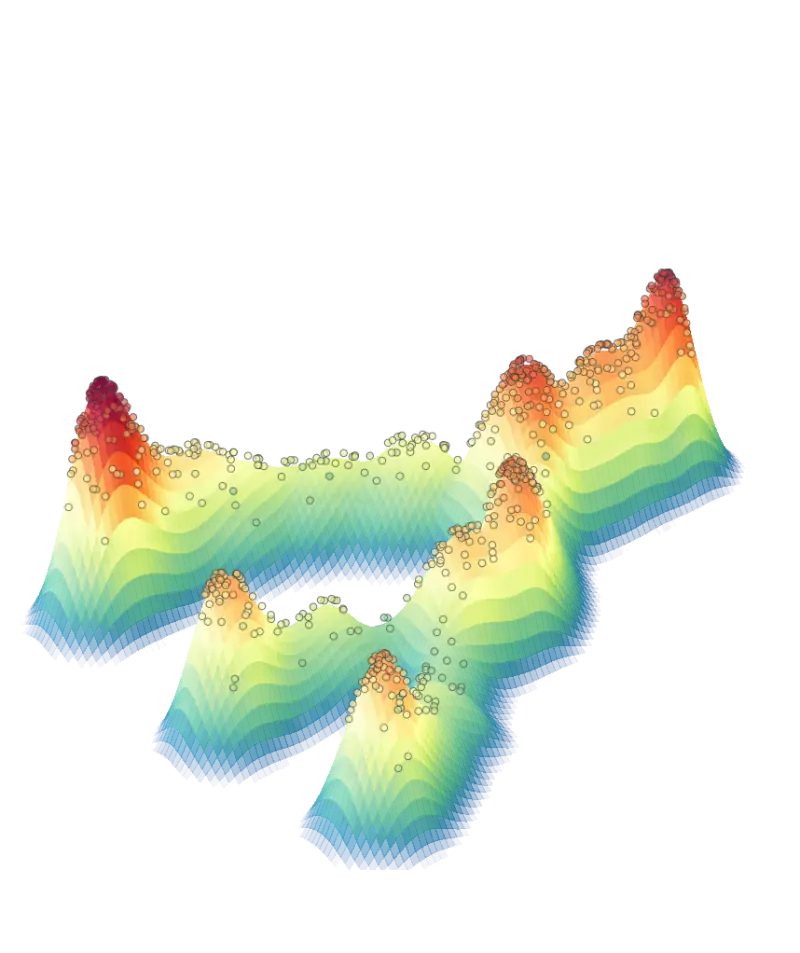
Synthetic cells along a branching tree of cell states, with their density drawn as a surface that rises where cells accumulate.
Synthetic cells. The density is estimated from them and drawn over a two-dimensional layout of cell states; it is not a tissue in 3D.
  1. Every cell is a point

    Single-cell genomics measures cells one at a time. Each cell is a point in a space with as many dimensions as there are genes, and cells that differentiate trace out a branching path through it.

  2. States, not only types

    Many stable states behave as attractors. These are what we recognize as cell types, and clusters summarize them well. Around and between them, cells vary continuously as they differentiate, divide, respond to stress and cycle. Rates and gradients live between clusters, so they cannot be expressed on them.

  3. The density is the readout

    Cells accumulate where change slows or where they divide, and thin out where change accelerates or cells die. How densely cells populate each state therefore carries the dynamics that produced it. Stable states are dense; transitions are sparse, and new lineages often emerge through them.

  4. Mellon makes it measurable

    Mellon infers this density from millions of real cells as a smooth, differentiable function, with uncertainty. It can be compared across conditions, followed over time and built into mechanistic models, which turns a snapshot of a tissue into a quantity that can be modeled. Nature Methods, 2024.

Why it matters for disease

A cell's expression could change in as many directions as it has genes, yet healthy cells use only a few of them. Transcription factors, enhancers, chromatin and signals from neighbors pull cells back when they stray. These are the guardrails of cell identity, and when one fails, identity gives way: deleting Pax5 lets committed B cells become T cells, and leukemic cells co-express lineage programs that healthy cells keep apart. Mutations, inflammation and drugs push cells off their usual states, and the guardrails decide whether they return or drift toward disease.

Clusters, trajectories and most models of cells learn from where cells are, and so see the few directions in which cells change. A model of the whole distribution, including how far it spreads, can also learn the many directions in which identity is defended. The goal is the small set of regulators that hold a tissue's states and fail first in disease: the targets for monitoring and intervention.

What the methods let biologists do

All are open-source, documented and maintained. Details and links are on the software page.

Mellon: find stable and transitional states

Ask which cell states are stable and which are transitional, and where along differentiation cells commit, from the density of cells in each state. In human hematopoiesis, B-lineage commitment passes a low-density window in which enhancers are primed and EBF1 activates.

Nature Methods, 2024 · Software

Kompot: compare conditions cell by cell

Compare young and old, treated and untreated, or mutant and wild type at every cell state, without first assigning cells to clusters. Changes that are graded along a transition or confined to part of a cell type stay visible, each with its uncertainty. Because nearby states share information, their estimates are correlated, and Kompot accounts for this when it adds up a gene's evidence, so small changes spread over many states count without being counted twice.

bioRxiv, under review at Cell Systems · Software

2for1separator: two chromatin profiles from one experiment

Read the accessible and the silenced regulome from a single CUT&Tag2for1 experiment in single cells, separated by statistical inference that treats each signal as continuous along the genome. Developed with the Henikoff laboratory.

Genome Biology, 2022 · Software

AnnZarro: explore very large datasets in the browser

Explore which cells and which genes resemble one another in very large single-cell datasets, one cell or gene at a time and linked to expression, in a viewer that reads only what is on screen and never changes the data.

bioRxiv, 2026 · Software

Future directions

My future laboratory will be computational and will work closely with experimental laboratories. Its program has three directions, each standing on its own and gaining from the others. All three model the tissue: the first follows how the distribution changes in time, the second places each state among its neighbors, and the third turns the model around to produce regulatory sequence from a described function.

  1. Guardrails. Learn, from measured distributions of cells, which regulation holds each state, which perturbations release it, and where it erodes with age or in leukemia. Funded by my K99/R00 award.
  2. Spatial context. Describe each cell's surroundings without first assigning cell types, so that spatial organization can be linked to cell state and compared across patients.
  3. Regulatory sequence design. Condition generative models of regulatory DNA on the behavior a state should show, and judge each design by whether that behavior follows.

More on the research page

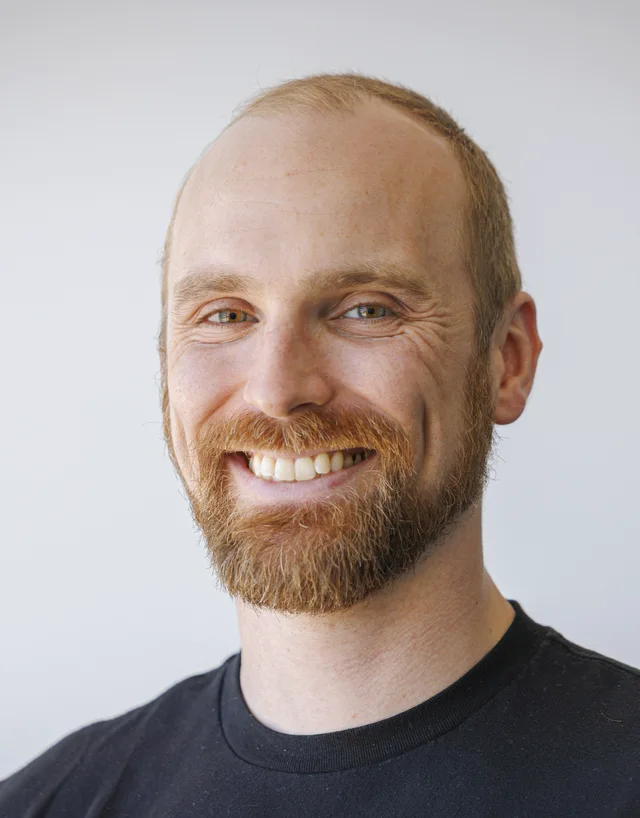
Dominik Otto
Photo: Robert Hood, Fred Hutch News Service

About

I came to biology from mathematics. After a bachelor's thesis in topology, my master's thesis at Freie Universität Berlin corrected a theorem on the determining nodes of gene regulatory networks, showing that not every feedback loop must be broken to control a network. I earned my PhD in informatics at Universität Leipzig, with research at the Fraunhofer Institute for Cell Therapy and Immunology on gene expression deconvolution and prostate cancer markers. Since 2021 I have been a postdoctoral fellow at Fred Hutch, the first member of Manu Setty's laboratory, where Mellon and Kompot were conceived.

Recent

  • Oct 2026
    AnnZarro preprint on bioRxiv, with Siddharth Baasri and Manu Setty.
  • Sept 2026
    Invited talk at the Bertinoro Computational Biology Meeting on spatial context in liver metastases.
  • May 2026
    Echo preprint, led by Connor Finkbeiner, on how gene expression and chromatin accessibility fall out of step during cell-state transitions.
  • 2025
    NIH K99/R00 Pathway to Independence Award from NIGMS: Mechanistic Inference of Tissue Dynamics from Multimodal Single-Cell Data.